

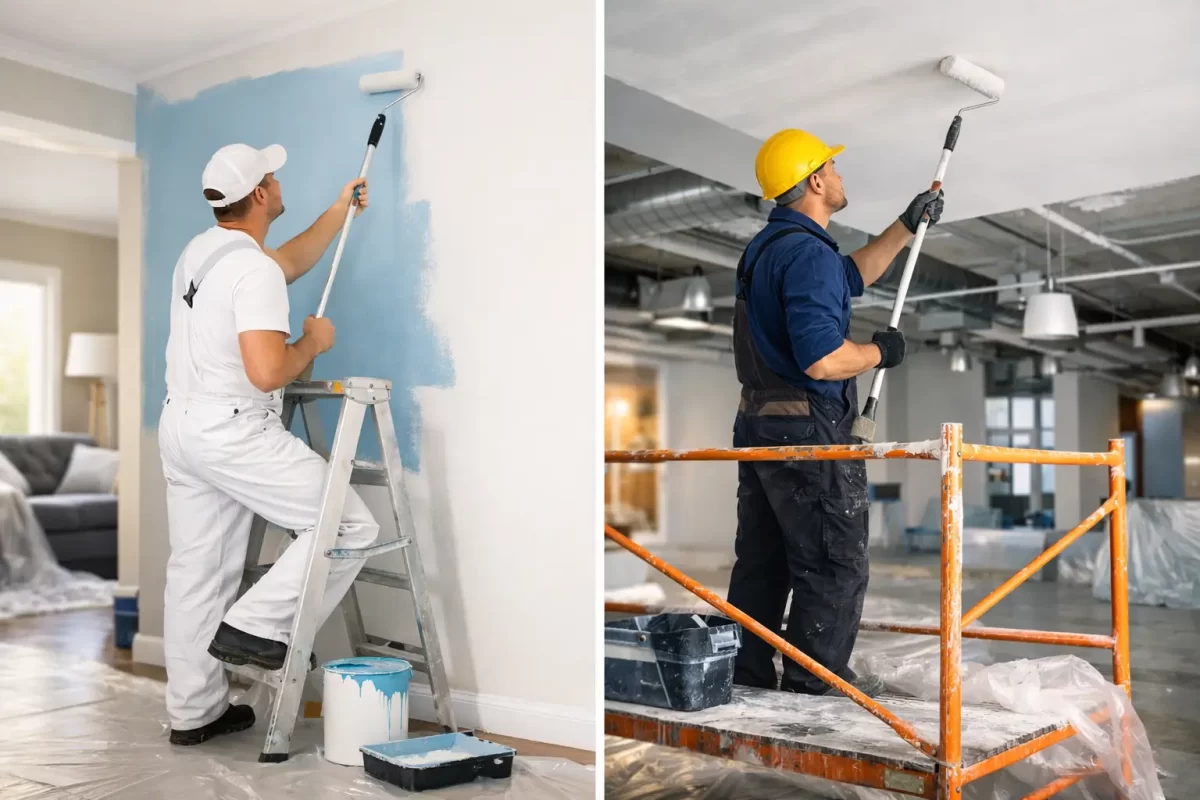
A fresh coat of paint can make two properties look equally sharp, but the work behind them can be completely different. Residential versus commercial painting is not just about whether the job is on a house or a business premises. It affects planning, product choice, site access, scheduling, safety requirements and the level of coordination needed to get the result right.
If you are comparing quotes or planning a project, understanding those differences helps you ask better questions and choose the right team for the work. It can also save you from delays, cost surprises and a finish that does not suit the space.
What residential versus commercial painting really means
Residential painting covers homes, townhouses, units and other living spaces. The focus is usually on presentation, comfort and long-term wear in day-to-day family life. That might mean repainting interiors, refreshing exteriors, repairing plaster before painting or getting support with colour selection so the final look suits the home.
Commercial painting applies to offices, retail spaces, strata common areas, hospitality venues, warehouses and other business or public-use properties. In these settings, the work often has to fit around staff, customers, tenants or operational hours. The appearance matters, but so does minimising disruption and meeting practical site requirements.
On the surface, both involve preparation, painting and finishing. In practice, the demands are often very different.
The biggest differences between home and business projects
The main difference is scale, but scale is only part of the picture. A residential project is often more personal. Homeowners are thinking about how rooms feel, how colours change with natural light and whether trades will treat the property with care. Communication matters because people are living in the space and want to know what is happening each day.
A commercial project tends to be more operational. Business owners and property managers are looking at timelines, access windows, safety controls, durability and whether the site can keep functioning during the works. They may also need a painter who can coordinate with other trades, building managers or fit-out schedules.
That means the same painting skill set is not enough on its own. The job also calls for the right systems, planning and site approach.
Surface preparation is rarely identical
In homes, preparation often involves patching dents, sanding trim, fixing minor plaster issues and protecting furniture, flooring and personal items. The goal is a clean, polished finish that holds up under everyday use.
In commercial settings, preparation may be more varied. There can be larger wall areas, higher traffic damage, grease or grime build-up, older coatings, access equipment and stricter site conditions. A warehouse wall, retail tenancy and office reception all need different preparation methods if the finish is going to last.
This is where experience matters. Good painting is never just about applying paint. The result depends on how well the surface has been repaired, cleaned and primed before the first top coat goes on.
Product selection changes with the environment
A family home and a busy commercial site do not wear paint in the same way. In residential interiors, clients often want low-odour products, washable finishes and colours that suit the style of the home. Bedrooms, living areas, kitchens and exteriors all have different performance needs.
Commercial properties usually need coatings chosen for durability first. High-traffic walls, shared amenities, shopfronts and workspaces may call for harder-wearing finishes that can handle repeated cleaning and general wear. In some settings, low-sheen may be preferred for a refined look, while in others a more practical finish makes better sense.
There is no single best product for every project. The right choice depends on how the space is used, how often it is cleaned and what sort of appearance the property needs to present.
Scheduling is one of the biggest practical differences
In most homes, painters can work during standard daytime hours as long as the occupants know what to expect. There may be some room-by-room planning to keep the household functioning, especially during interior work, but the site is usually more straightforward to access.
Commercial painting often works to tighter constraints. Some jobs need to happen after hours, on weekends or in stages so the business can keep operating. An office may need minimal interruption during work hours. A retail shop may only allow access outside trading times. A strata property may need notice periods and coordination with residents.
This can affect cost, timeframe and labour planning. It is one of the clearest examples of why residential versus commercial painting should not be treated as interchangeable when comparing quotes.
Safety, compliance and access can add complexity
Home projects still require safe, careful work practices, especially for exterior painting or multi-level homes. But commercial sites often involve another layer of complexity. There may be formal site inductions, access rules, height equipment, restricted areas or other contractors working nearby.
That does not mean commercial work is always more difficult. Some office interiors are quite straightforward. But it does mean commercial painters need to be comfortable operating within site procedures and keeping the project organised from start to finish.
For property owners, this is worth checking early. A painter may be excellent in homes but not set up for larger or more regulated sites. The reverse can also be true. A team used to broad commercial work may not always bring the same level of detail and care expected inside an occupied home.
Expectations around finish are different, but quality still matters
Residential clients are usually highly focused on detail. They notice cut-in lines, surface smoothness, patched areas, sheen consistency and how colours sit across connected spaces. That is fair enough. In a home, you live with the result every day.
Commercial clients also expect a professional finish, but they may prioritise performance and presentation in a different way. A reception area, showroom or medical suite may require a very polished appearance. A back-of-house area may be more focused on durability and clean coverage than decorative detail.
The point is not that one matters more than the other. It is that quality looks slightly different depending on the setting and purpose of the space.
Cost differences are not always as simple as size
People often assume commercial painting will always cost more because the buildings are bigger. Sometimes that is true, but not always. A compact commercial job with difficult access, staged work and after-hours scheduling can be more complex than a larger residential repaint.
Likewise, a detailed home interior with premium finishes, extensive preparation and careful protection of furnishings may take more labour than expected. Cost usually comes down to the combination of surface condition, access, product selection, timeframe and the amount of coordination required.
That is why clear quoting matters. A proper quote should reflect the actual needs of the project, not just the square metres on paper.
How to choose the right painter for the job
The best painter for your project is not simply the cheapest or the one who can start first. You want someone whose experience matches the type of property, whose preparation standards are clear and whose communication gives you confidence from the start.
For a home, look for a team that respects the space, explains the process properly and can offer practical guidance on finishes and colour choices. For a commercial property, look for a contractor who understands scheduling, site management and how to keep the work moving with minimal disruption.
If your project includes repairs, plastering or advice on presentation, it also helps to work with a team that can manage more than just paint application. That tends to make the process smoother and the final result more consistent.
When the line between residential and commercial starts to blur
Some projects sit in the middle. Strata complexes, home offices, mixed-use properties and renovated investment properties do not always fit neatly into one category. In these cases, the right approach depends on how the space is used, who needs access and what standard of finish is expected.
A good contractor will not force the project into a standard template. They will assess the site, ask the right questions and tailor the work plan to suit the property. That practical approach is often what keeps a straightforward job from becoming a stressful one.
For property owners on the Gold Coast and in Tweed, that local understanding can be especially helpful when exterior conditions, access and project timing all play a part.
Choosing between residential and commercial painting is really about choosing the right method for the building in front of you. When the planning, preparation and finish all match the space, the result lasts longer and feels right from day one.


